
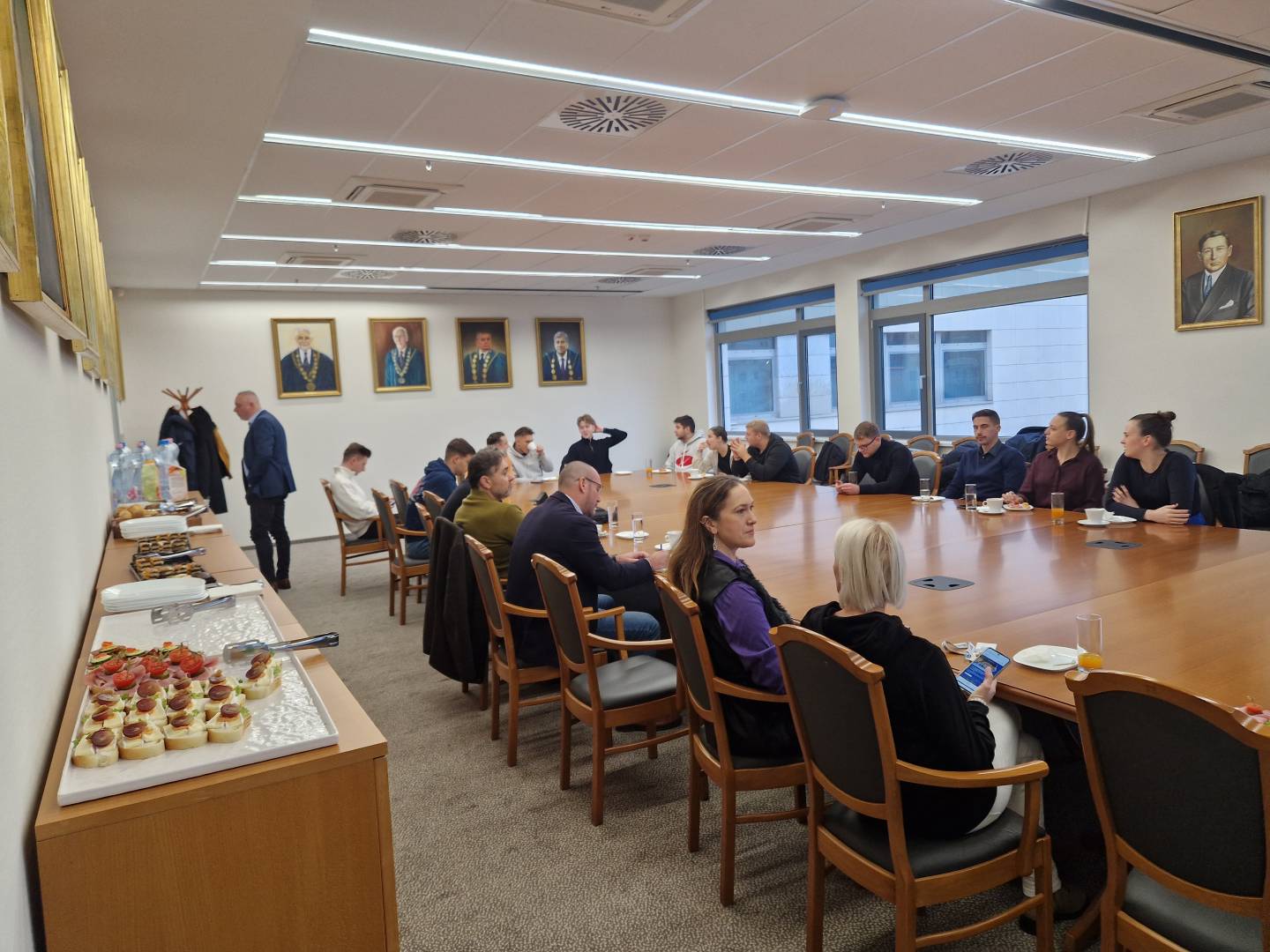
On November 20, the TF once again welcomed interested parties to its thematic, open “Sports” Working Breakfast, which created an opportunity for a joint overview and discussion of the European Union’s sports-related policy issues in the framework of an informal morning conversation.
The program started with an informal conversation over coffee, tea and breakfast snacks, and then Dr. Péter Farkas, project leader and associate professor at the Department of Social Sciences, gave an introductory lecture entitled “The institutional system of the European Union, with special regard to the rotating presidency of the Council of the EU”. In his lecture, he reviewed the foundations of the EU’s institutional operation and highlighted the role of the rotating presidency of the Council in decision-making processes and in shaping policy priorities. Afterwards, Dr. Roland Liszkai, Head of the International Sports Relations Department (Sports Management Department, State Secretariat for Sport of the Ministry of the Interior), shared his experiences under the title “Presidency in practice, first-hand experiences” and presented from a practical perspective how the rotating presidency of the Council of the EU appears in the international professional work carried out in the field of sport, and along what aspects the coordination of related tasks takes place.
The professional program of the Hungarian rotating presidency of the Council of the EU, which will take place between 1 July and 31 December 2024, clearly prioritized two major focuses: strengthening health-enhancing physical activity (HEPA) and consciously managing the legacy of major sporting events. The sports policy messages of the semester emphasized that sport is not only competition and performance, but also a tool for health development, education, community building and social integration, the role of which is worth interpreting within the broader framework of the European sports model.
One of the highlights of the Hungarian Presidency’s professional work on sport took place in Budapest on 11–12 July 2024, when a two-day professional meeting of sports directors from EU Member States took place. The agenda of the forum also included HEPA and the legacy of major sporting events: the focus of the professional discussions was on how major sporting events can be planned and implemented in a way that has tangible health, social and sports development effects in the long term, and how sport and physical activity can be promoted more widely – especially among young people and hard-to-reach groups.
During the semester, sport topics also appeared on the Council’s formal agenda, especially in the framework of the Education, Youth, Culture and Sport Council (EYCS). A key date for sport was 26 November 2024, when the Council also met with a sports agenda. This meeting is also expected to adopt Council conclusions that highlight the economic, social and environmental sustainability of hosting major sports events, and reinforce the approach that major events should also be used to promote sport and physical activity on a broad scale. Policy emphases include planning and measuring long-term impacts, increasing social utility, and consciously incorporating sustainability considerations into hosting decisions.
Overall, the 2024 professional programme of the Hungarian Presidency of the Council of the EU in the field of sport is structured along a clearly delineated logic: the topics of HEPA and the legacy of major sports events appeared simultaneously in professional consultation forums and in the formal decision-making processes of the Council. This dual focus sends the message that sports policy goals can only be truly effective if the promotion of everyday physical activity and the long-term social benefits of major sports events are addressed within the same strategic framework.
The professional block was followed by questions and a short exchange of ideas, followed by informal discussions and professional networking. The working breakfast was also a valuable meeting point for students, lecturers and professional partners: it provided an overview of the institutional functioning of the EU and tangible, practical experiences of international cooperation in the field of sport.
The event was implemented as part of a three-year, EU-funded Jean Monnet project: the initiative not only supports the development of courses related to EU studies offered at the Faculty of Law, but also elements that strengthen knowledge sharing and community building, such as the creation of a thematic corner in the Faculty of Law Library, the inclusion of lectures and research on the topic of the EU, physical education and sport in the program of the Klebelsberg Kuno College, and the organization of thematic, open working breakfasts.


